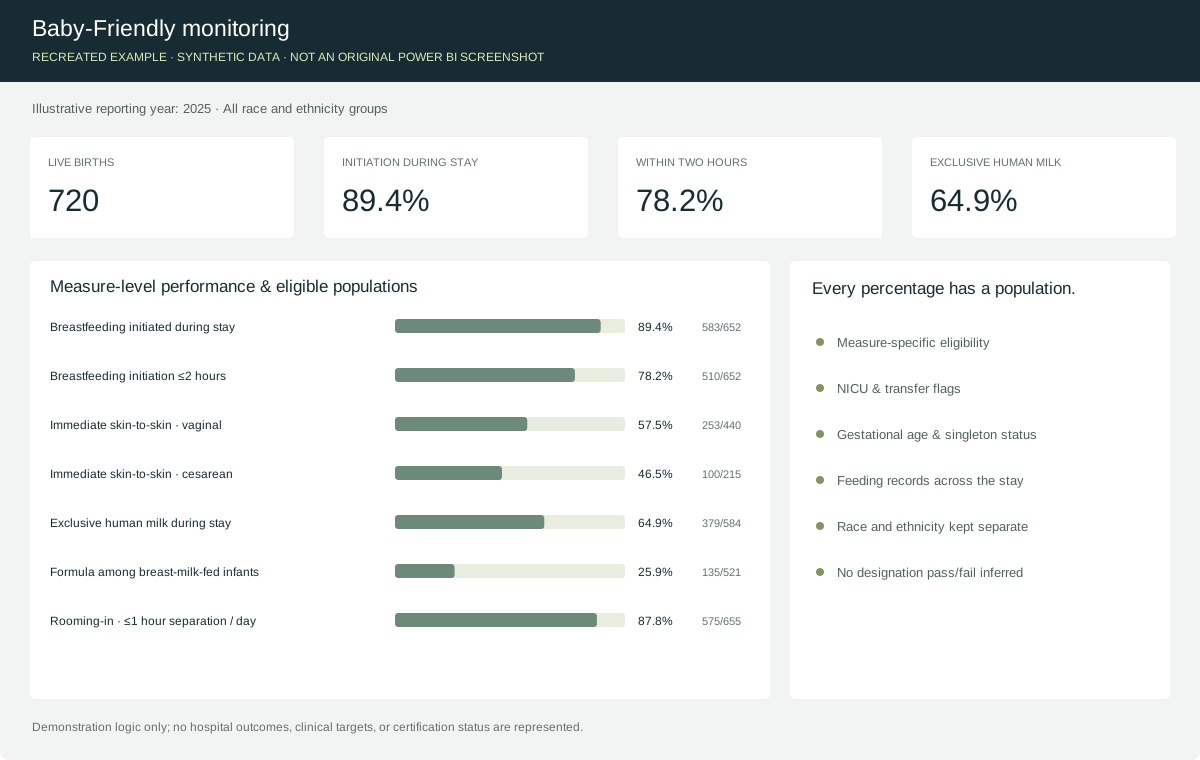
Measure-level rates & eligible populations
| Measure | Numerator | Denominator | Rate |
|---|
Births by delivery method
| Delivery method | Births | Share |
|---|
What a leader can investigate
Compare early initiation with initiation at any point in the stay. Examine skin-to-skin documentation separately for vaginal and cesarean births. Review subgroup differences alongside their denominators before deciding what needs follow-up.
These are questions supported by the demonstration, not findings from a real hospital. A supplementation rate alone does not establish inappropriate care; clinical indications and informed parental choice matter.
Stratified view
| Group | Live births | Initiation ≤2 hours · n/d | Exclusive human milk · n/d |
|---|
Race and ethnicity are separate recorded fields. “Not documented” is retained; no identity is inferred.
How the example calculates rates
Rate = eligible infants meeting the measure ÷ eligible infants × 100. A zero denominator displays “—”, not 0%.
Eligibility and interpretation notes
Initiation: excludes NICU admissions, transfers, and galactosemia. The early measure also requires documented initiation within 120 minutes of birth.
Exclusive human milk: uses singleton, term infants discharged alive, excluding NICU, transfers, galactosemia, and parenteral nutrition. Formula or other non-human-milk liquid disqualifies the example numerator. Direct, expressed, and donor human milk belong in a production feeding classification.
Formula supplementation: the denominator is the eligible exclusive-measure cohort who received any human milk; the numerator received formula as well. Clinical reasons are not modeled here.
Skin-to-skin: separates delivery methods and requires both an immediate-contact flag and at least 60 uninterrupted minutes. This simplified demo excludes NICU and transferred infants; safe/feasible timing, medical exceptions, and complete source documentation require the applicable facility specification.
Rooming-in: uses a precomputed flag for no separation exceeding one hour in any 24-hour period; excludes NICU and transfers. A real implementation requires interval-level separation records.
This is an illustrative implementation, not the current official Facility Data Sheet or a certification calculator. It omits detailed exception adjudication and does not assign compliance targets. For formal reporting, use the facility’s applicable BFUSA instructions and validated source mappings.
Independent portfolio demonstration. Baby-Friendly USA is the program authority; no endorsement is implied. Official Facility Data Sheet context ↗