Baby-Friendly maternity quality reporting
Built the SQL-to-Power-BI reporting foundation used to answer Baby-Friendly facility-data questions, with measure-specific eligibility, feeding and care-practice rates, and race/ethnicity breakdowns.
Several questions. One reporting foundation.
- How many live births occurred during the reporting year, and what was the delivery-method distribution?
- What proportion of eligible infants initiated breastfeeding during the stay and within the first two hours after birth?
- For vaginal and cesarean births separately, how often was immediate, uninterrupted skin-to-skin contact documented for at least one hour?
- Among eligible infants, how often was human milk exclusive throughout the stay, and how often did breast-milk-fed infants receive formula?
- How often did eligible mothers and infants remain together day and night without a separation exceeding one hour per 24-hour period?
- How do these measures differ by recorded race and ethnicity, and where should the care team investigate further?
From source records to decision support.
Owned the development of a pre-Epic reporting solution, writing complex SQL against the available clinical databases to assemble the dataset and building the Power BI dashboard that translated it into counts, percentages, and stratified tables. Converted reporting instructions into distinct numerator and denominator logic rather than applying one population to every measure. Incorporated eligibility conditions such as NICU admission, transfer, gestational age, singleton status, galactosemia, and parenteral nutrition where relevant to the measure.
What made the work demanding
The difficult work was connecting clinical events across a hospitalization while preserving the correct infant-level reporting grain. “Any breastfeeding,” “within two hours,” “exclusive throughout the stay,” and “formula among breast-milk-fed infants” answer different questions and cannot share an interchangeable denominator. Skin-to-skin also requires timing and continuity, not just a documented contact event.
What the work enabled
Equipped quality and maternity teams to monitor the care practices represented in the facility reporting requirements, examine subgroup differences, and identify where documentation or practice needed review. The reporting supported assessment against applicable Baby-Friendly guidance; it did not itself establish designation, guarantee adherence, or demonstrate that every rate met a universal target.
What the reporting covered.
| Area | Reporting scope | Decision context |
|---|---|---|
| Annual volume | Live births · Vaginal / cesarean delivery share | Establish reporting populations and delivery context. |
| Initiation | During hospitalization · Within two hours | Distinguish eventual initiation from early initiation. |
| Skin-to-skin | Immediate and uninterrupted ≥1 hour · Separate delivery methods | Evaluate both timing and duration. |
| Feeding during stay | Exclusive human milk · Formula among breast-milk-fed infants | Apply different eligibility and denominator rules. |
| Rooming-in | Day and night · Separation ≤1 hour per 24-hour period | Evaluate continuity across the stay. |
| Stratification | Race and ethnicity | Review rates with subgroup counts and documented missingness. |
A dashboard you can explore.
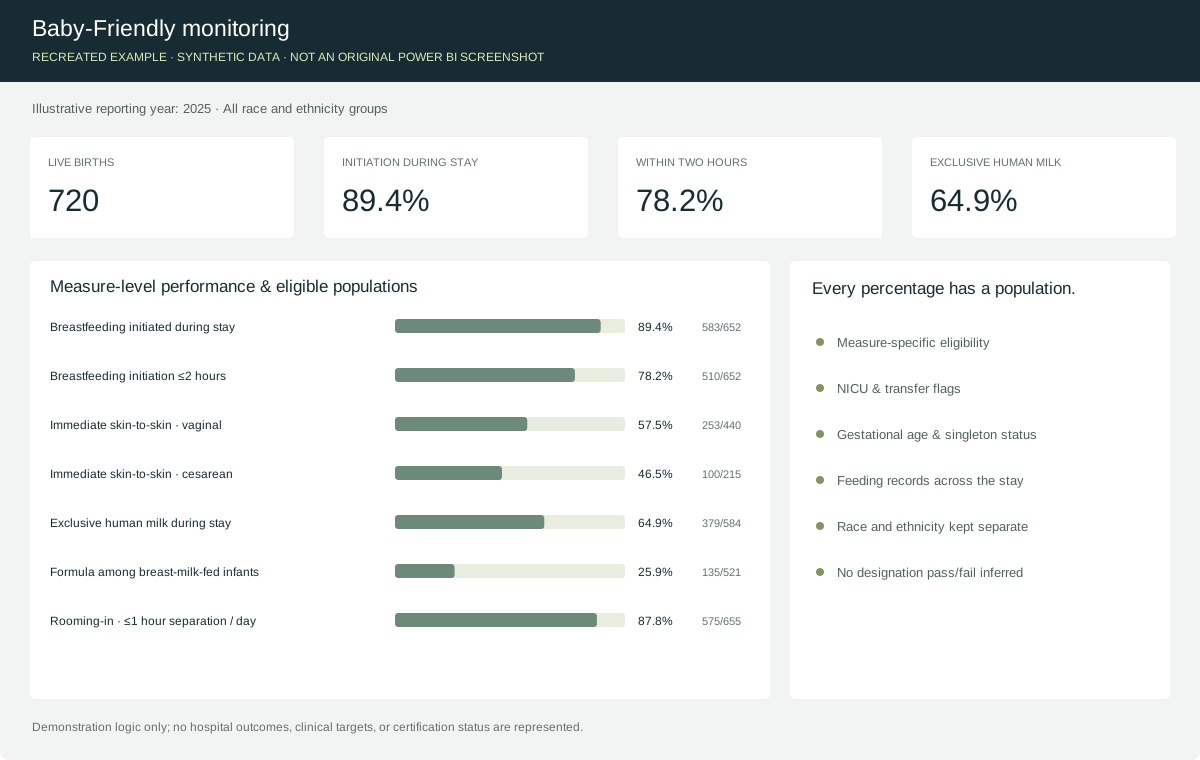
The full-year preview is illustrative. Open the demonstration to change filters and see the calculations update. Numerators and denominators remain visible; no certification threshold is inferred.
SQL samples are newly written demonstration patterns using fictional table names, not the original employer queries. No confidential schema or production code is disclosed.
Numbers that can be explained.
These checks make the analytical approach concrete. Where original validation artifacts are unavailable, this section describes the relevant checks rather than implying a published audit trail.
Check for duplicate infants after joining encounters, feeding documentation, diagnoses, and care events; reconcile annual live births to the source total.
Trace inclusion and exclusion flags to source records and confirm that exclusions apply to the relevant measure, rather than every measure indiscriminately.
Test birth-to-initiation intervals, immediate-contact criteria, uninterrupted skin-to-skin duration, and separation intervals at boundary values.
Inspect feeding classifications across the entire hospitalization, including expressed / donor human milk and documented supplementation.
Ensure subgroup counts reconcile to totals, retain unknown categories, and display numerator / denominator counts alongside percentages.
Use record-level samples and aggregate checks against the clinical documentation and stakeholder expectations. These are the validation checks illustrated by this case study, not a claim that a supplied audit log has been reviewed.
Reporting context, used carefully.
BFUSA describes its Facility Data Sheet as a tool for collecting facility information and measures including breastfeeding initiation and exclusivity. The relevant facility instructions govern formal numerator, denominator, and exception rules. This portfolio summarizes the project as described, rather than reproducing a current official specification.
Monitoring a measure and certifying a facility are different activities. The portfolio therefore does not label the hospital compliant or imply that a single exclusive-breastfeeding percentage determines designation.
Official references: Facility Data Sheet context ↗ · BFUSA clarification on thresholds and supplementation ↗